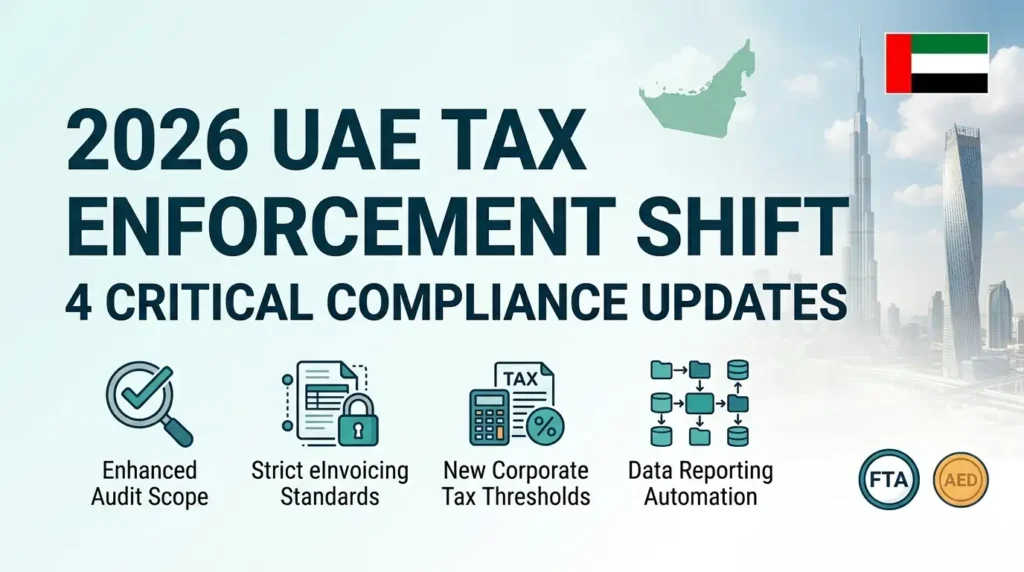
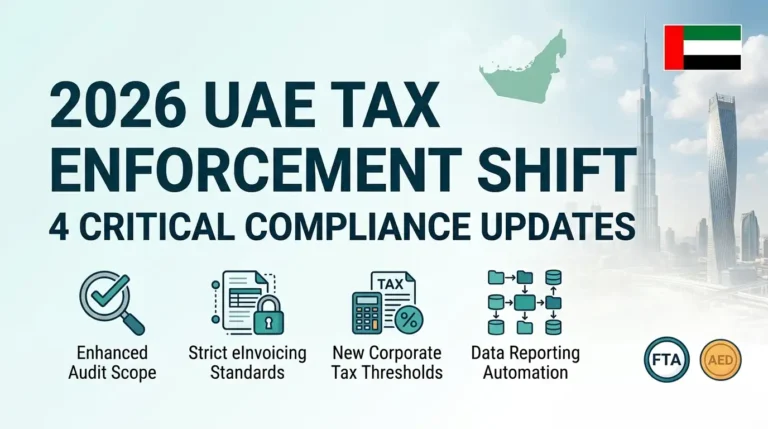
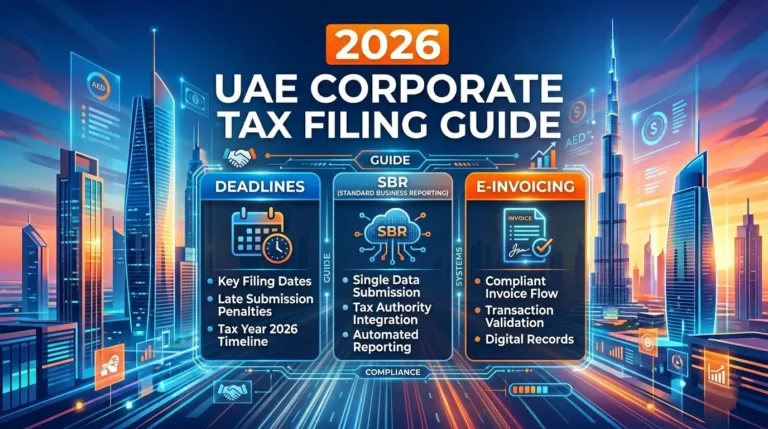
Navigating the 2026 UAE Tax Enforcement Era: 4 Critical Compliance Updates for Every Business
For the past few years, businesses across the UAE have operated within an “adaptation window.” The Federal Tax Authority (FTA) prioritized market education, helping organizations set up their corporate accounts and understand the foundations of Corporate Tax (CT) and Value Added Tax (VAT).
In 2026, that grace period has officially ended. The landscape has fundamentally shifted from initial registration to decisive enforcement and audit readiness.
At The Capital Zone Accounting, we are seeing a massive surge in corporate compliance checks and strict timeline enforcement. To protect your corporate structure and avoid severe administrative penalties, your finance and bookkeeping workflows must adapt to these four critical regulatory updates.
1. Mandatory Audited Financials for All Qualifying Free Zone Persons (QFZPs)
One of the most profound changes facing free zone entities involves statutory audit requirements. Previously, many free zones only demanded audited financial statements upon license renewal, and small-scale operations often bypassed them entirely.
Under the matured framework, all Qualifying Free Zone Persons (QFZPs) looking to claim the 0% Corporate Tax rate must maintain audited financial statements, regardless of their revenue size.
The Catch: If you fail to prepare IFRS-compliant, audited books, you risk losing your QFZP status entirely.
The De Minimis Risk: The strict 5% or AED 5 million de minimis threshold for non-qualifying revenue is being intensely monitored. If your business breaches this line, you face a flat 9% tax rate for five consecutive years with absolutely no room for reversion.
2. The New Fixed 5-Year Expiry on VAT Refunds and Tax Credits
A strict amendment that caught many corporate accountants off guard is the introduction of a definitive five-year limitation period on VAT recoveries and tax credit usage.
The 2026 Rule: Under the updated federal tax laws, businesses can carry forward excess recoverable VAT or unutilized corporate tax credits for a maximum of five years from the end of the relevant tax period. Any balance not claimed or utilized within this window will permanently lapse.
If your accounting team has been rolling over old tax credits on the balance sheet from 2018 to 2021 without formal recovery applications, those balances are now at immediate risk. Organizations must run an immediate reconciliation audit to identify aging tax balances and file formal refund requests through the EmaraTax portal before they expire.
3. The Elimination of Reverse Charge VAT Self-Invoicing
To simplify compliance workflows but increase the burden of validation, the FTA has removed the mandatory requirement for businesses to issue a self-generated tax invoice under the Reverse Charge Mechanism (RCM) for imported goods and services.
While this cuts out duplicate administrative data entry, it shifts 100% of the audit burden onto your external tracking:
Old Way: You issued a self-invoice to declare and recover input VAT on foreign services.
New 2026 Standard: You must maintain a bulletproof trail of original supplier contracts, international bank wire receipts, and customs declarations.
During an FTA check, any input VAT recovered under RCM without an immaculate, verifiable paper trail from the actual overseas supplier will be instantly disallowed under the strengthened “Should Have Known” anti-evasion principles.
4. Cross-Tax Systems Alignment: The Era of Data Reconciliation
The FTA’s auditing software has become highly sophisticated. In 2026, automated scripts systematically cross-reference every data stream your business outputs.
The authority now directly cross-analyzes:
Your annual Corporate Tax returns.
Your quarterly or monthly VAT filings.
Your Economic Substance Regulations (ESR) notifications.
Your UAE Customs import/export ledgers.
If your corporate tax filing shows an operating margin or revenue baseline that fails to align perfectly with your customs declarations or quarterly VAT returns, it triggers an immediate automated red flag for an in-person audit.
Summary: The 2025 vs. 2026 Compliance Landscape
| Compliance Area | Old Protocol | 2026 Enforced Protocol |
| Free Zone 0% CT Rate | Based on self-declaration & registration | Mandatory IFRS audits regardless of revenue size |
| Tax Credit Balances | Indefinite carry-forward allowed | Strict 5-year expiration cap from the tax period end |
| Reverse Charge VAT | Requires self-generated invoices | Dependent entirely on original supplier evidence & customs links |
| Audit Philosophy | Regulatory education and guided corrections | Enforcement, strict penalties, and cross-filing checks |
Is Your Business Audit-Ready?
In this era of tight enforcement, a baseline bookkeeper is no longer enough to protect your enterprise. The most costly mistake a UAE business can make is treating tax compliance as a year-end afterthought rather than a day-to-day operational framework.
At The Capital Zone Accounting, we protect your commercial assets by installing enterprise-grade bookkeeping, structured transfer pricing files, and rigorous pre-audit checks directly into your monthly corporate routine.
Ensure your corporate ledgers meet the latest 2026 FTA compliance standards.
Book a comprehensive corporate review with our senior audit team today: https://czaccounting.com/contact-us/